CODEerts

Odoo Employees
Odoo HR: Employee Records That the Rest of the Business Can Use
Odoo HR is a set of small apps that share one employee record. Individually none of them will beat a dedicated HR platform. Together they mean your project costing, your payroll and your leave calendar are finally reading the same data.
Written by Muneeb AhmadOdoo 19 and 17 Certified, Functional Consultant
01
What Odoo HR actually is
Odoo HR is not one module. It is a group of apps that share a single hr.employee record: Employees, Time Off, Attendances, Recruitment, Appraisals, Expenses, and Payroll where the country localisation supports it.
Judged individually, each is competent rather than exceptional, and a dedicated HR platform will beat any of them on depth. The reason to run HR in Odoo anyway is that the employee record is the same one your projects cost against, your timesheets belong to, your expenses are claimed by, and your payroll pays. In most organisations that data lives in three systems that disagree, and reconciling them is somebody's recurring job.
02
The employee record and the access decision inside it
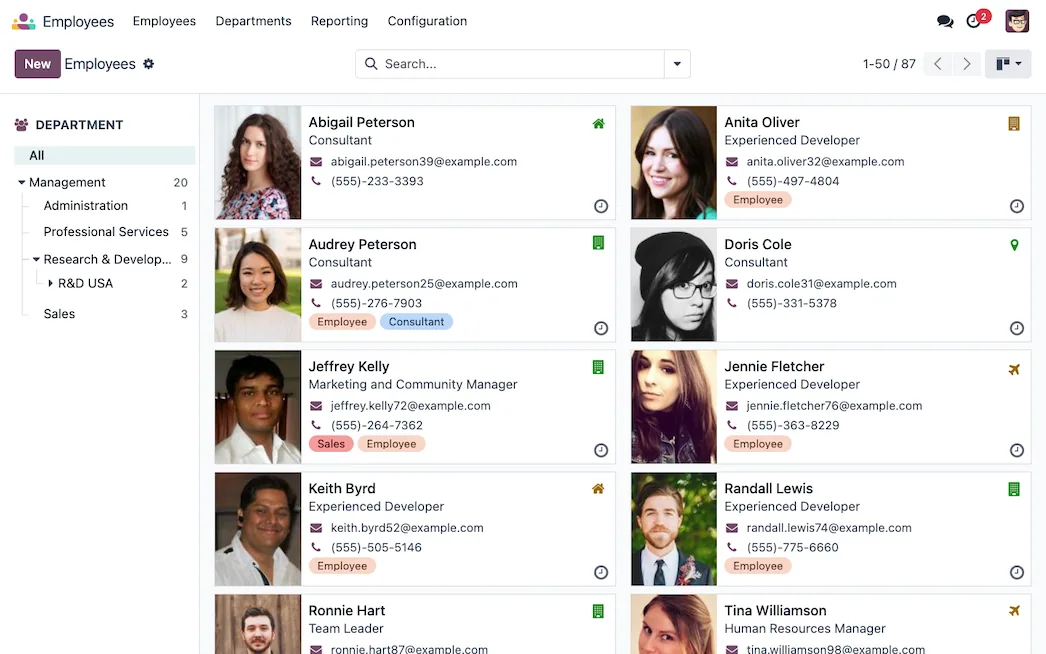
Everything hangs off the employee record: department, job position, manager, work location, contact details, contracts, documents.
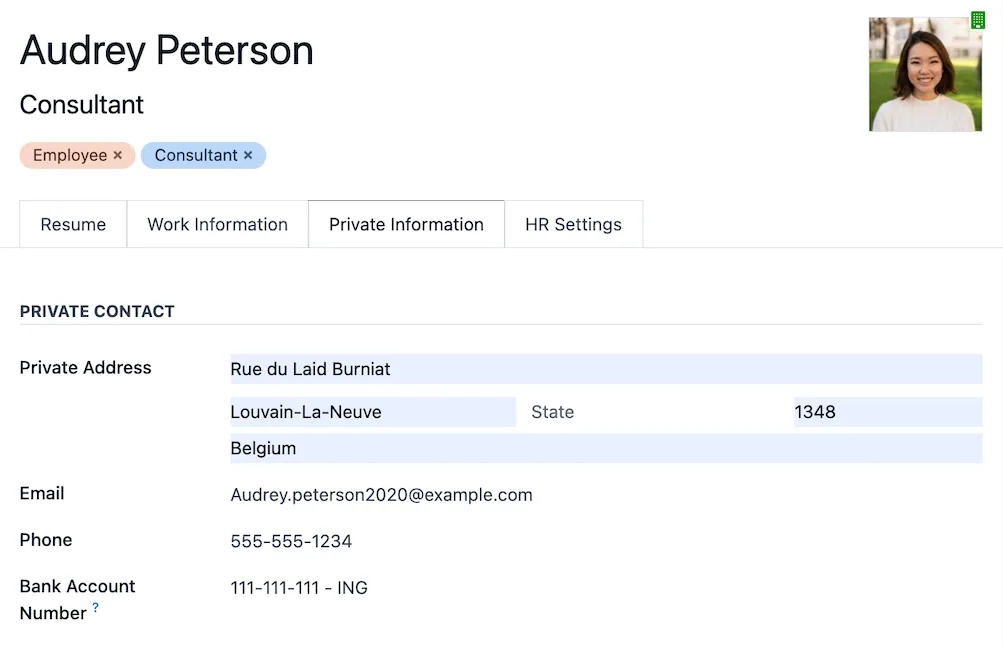
The important structural feature is that the record separates public information from an HR settings section that holds salary, identification numbers, bank details and private contact information. That second section is restricted to HR officers.
Getting this right is the highest-stakes configuration in the module, and it is worth being deliberate rather than accepting defaults. Decide explicitly who is an HR officer, who is merely a manager, and what a manager can see about their own reports. It is much easier to widen access later than to explain why a team lead could see salaries for a month.
Departments and reporting lines are worth setting up accurately even in a small company, because approval routing for leave and expenses follows them.

03
Time off, which is where adoption usually starts
Time Off handles leave types, allocations, requests, approvals and the calendar that results. Employees request from the portal or the mobile app, managers approve, balances update.
This is normally the first module to land well, because it removes a genuinely irritating manual process for everyone at once. A few decisions repay attention up front: whether allocations accrue or are granted annually, whether unused leave carries over, whether some leave types need a second approval, and which public holiday calendar applies to which working schedule.
Working schedules matter more than people expect. They define what a working day is, and every leave calculation, attendance figure and capacity number depends on them. A company with part-time staff or multiple locations should model these properly before rolling anything out.
04
Attendance and timesheets, which are not the same thing
Attendance records presence: in at 09:02, out at 17:31, from a browser, a phone or a shared kiosk with a PIN or badge.
Timesheets record allocation: three hours on this task, two on that one.
Businesses conflate these and then wonder why the numbers do not agree. They answer different questions. A factory needs attendance and may not need timesheets at all. A consultancy needs timesheets and may not care about attendance. Some regulated environments need both, and should expect them to differ slightly, because a person present is not a person billing.
Screenshots of Odoo are the property of Odoo S.A. and are shown here to illustrate the app they depict.
Appraisals, recruitment and expenses
Appraisals support a scheduled review cycle with templates for employee self-assessment and manager feedback, plus a private manager section. It handles an annual or semi-annual cycle well. It is not a continuous performance platform and should not be sold internally as one.
Recruitment runs a hiring pipeline as a kanban of applicants per job position, with an email alias per position so applications arrive automatically. A hired applicant becomes an employee record without re-entry, which is a small thing that saves a reliably annoying task.
Expenses lets employees submit claims with a receipt photo, routes them for approval, and posts approved claims to Accounting. Where expenses are project-related they carry the analytic account, which is how they reach project profitability rather than disappearing into overhead.
Where Odoo HR will fight you
Payroll is a separate conversation. It is Enterprise and it is country-specific. The quality of the localisation for your country determines whether it is a strong fit or a large custom project, and that answer varies enormously. Establish it early.
Depth is moderate across the board. Complex shift patterns, sophisticated performance frameworks, workforce planning at scale and detailed compliance reporting are all areas where dedicated software is further ahead.
Access rights need real thought. This is worth repeating because it is the one mistake that damages trust rather than just data.
Document management for HR files is basic in Community. The Documents app that handles this properly is Enterprise.
How it connects to everything else
Employees are the users your timesheets belong to and the cost rates your project profitability uses. Time off reduces available capacity in planning and scheduling. Expenses post to Accounting and to project analytic accounts. Recruitment feeds the employee record. Payroll, where available, posts its journal entries into the same ledger.
The value is the absence of a monthly reconciliation between an HR system and a finance system, which is a task most organisations have simply accepted as permanent.
Where to start
Configure working schedules and departments before anything else, because leave, attendance and approvals all depend on them. Decide the access-rights model explicitly and check it by logging in as a manager. Roll out Time Off first, since it is the module people are gladdest to receive. Answer the payroll localisation question early and separately. Then add attendance or timesheets only once you can say which question you are trying to answer with them.
FAQ
Odoo Employees, answered.
Is Odoo HR free?
Employees, Time Off, Attendances, Recruitment and Expenses are all in Community. Payroll is Enterprise and is also country-specific, so treat payroll as a separate decision from the rest of HR rather than assuming it comes along.
Can employees request time off themselves?
Yes, through the portal or the app, and the request routes to their manager for approval. Approved leave appears on the team calendar and reduces the remaining allocation automatically. Self-service is the main reason most teams adopt this module.
How is attendance tracked?
Employees check in and out from the web, a mobile device, or a shared kiosk with a PIN or badge. Attendance is separate from timesheets: attendance records presence, timesheets record what the time was spent on, and a business can legitimately need either or both.
Does Odoo do payroll?
Payroll is Enterprise and depends on a country-specific localisation package for salary rules and statutory reporting. Whether it fits depends entirely on whether your country's package is complete, so check that specific question early rather than assuming.
Can I stop managers from seeing sensitive employee data?
Yes. Employee records separate public information from an HR settings section covering salary, identification and private contact details, visible only to HR officers. Getting these groups right is the most important configuration decision in the module.
How do appraisals work?
Appraisals can be scheduled on a recurring cadence, with templates for employee and manager feedback and a private manager section. It supports a straightforward review cycle well and is not a full continuous-performance platform.
Related
Keep exploring.
Other Odoo apps we have written up in the same depth.
With CODEerts
Want this set up properly?
We are certified Odoo partners. We implement, customise and support Odoo Employees, and we publish our own apps on the Odoo Store.
See how we can helpBook a callReady to make Odoo work the way your business does?
Book a free call CODEerts
CODEerts is a team of certified Odoo partners and full-stack engineers. We implement, customise and support Odoo ERP, then build the software around it.