CODEerts

Odoo Recruitment
Odoo Recruitment: A Hiring Pipeline That Ends in an Employee Record
Recruitment in Odoo is a competent applicant tracker with one structural advantage over the dedicated tools: the person you hire becomes an employee record without anyone retyping anything, and the job they were hired into is the one your org chart already knows about.
Written by Muneeb AhmadOdoo 19 and 17 Certified, Functional Consultant
01
What Odoo Recruitment actually is
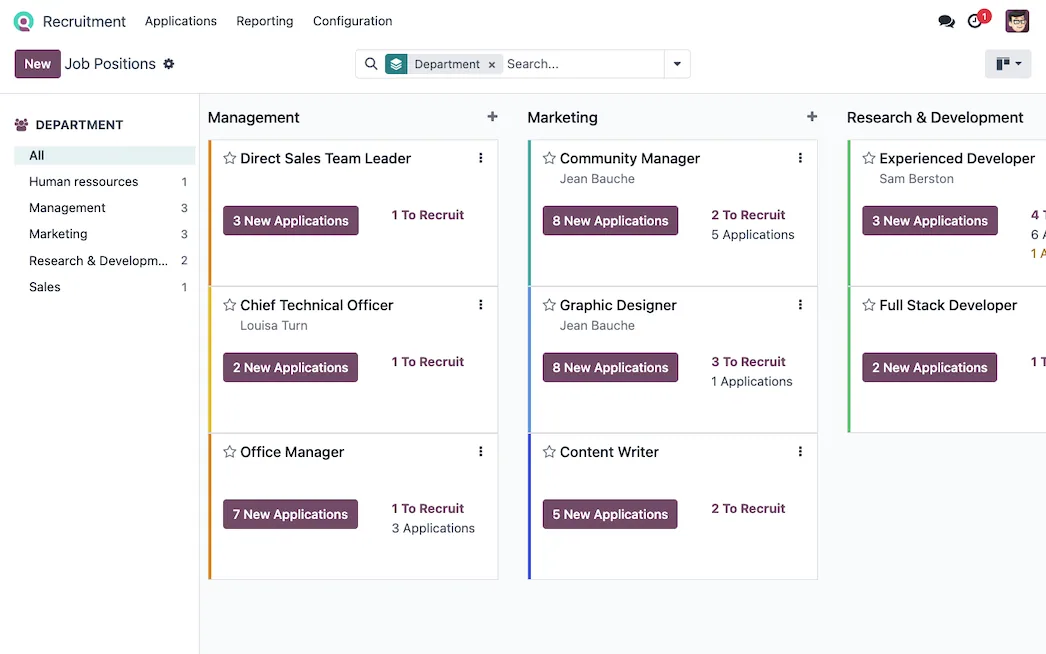
Odoo Recruitment tracks applicants against open job positions through a kanban pipeline, from application to offer to hire. Measured against dedicated applicant tracking systems it is mid-range: it does the core well and lacks the sourcing, job-board syndication and analytics depth of the specialists.
Its advantage is the join. The job position is the same one attached to your departments. The applicant who accepts becomes an employee record with their documents already attached. For a company hiring a handful of people a quarter, that removes the double entry and the "which spreadsheet has the CVs" problem, which is most of the pain at that scale.
For a company hiring at volume, evaluate the specialists seriously. The gap is real.
02
Job positions, which are more than a job advert
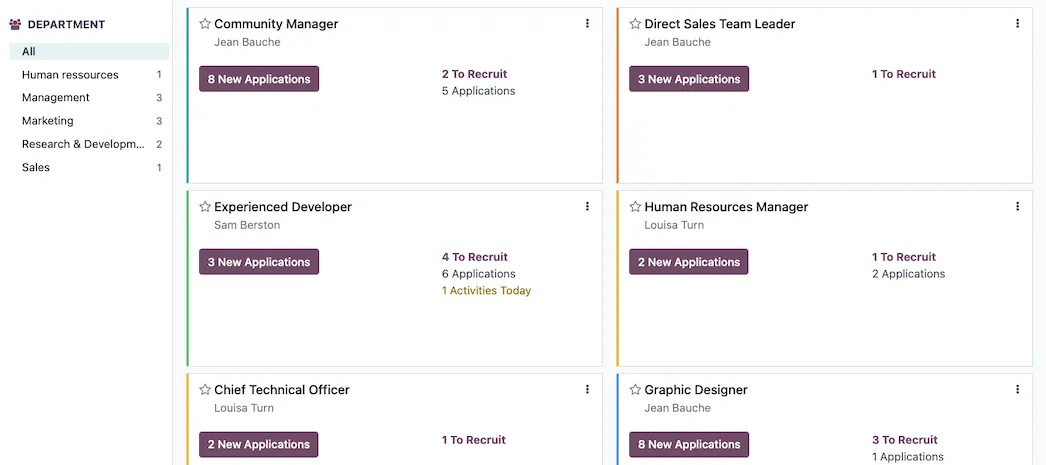
A job position holds the role, department, expected number of recruits, the recruiter responsible, the published description, and the interview form. Publishing it puts it on your website careers page.
Two settings repay attention. The email alias per position turns a mailbox into an intake channel, so a CV sent to it lands as an applicant with the attachment on the record and no forwarding. The expected recruits number makes the pipeline meaningful, because it is the difference between "we have twelve applicants" and "we have twelve applicants for two seats".
Keeping positions closed when they are filled matters more than it sounds. An open position that is not really open collects applications nobody reads, which is a small reputational cost paid repeatedly.
03
The pipeline, and stages that describe the candidate
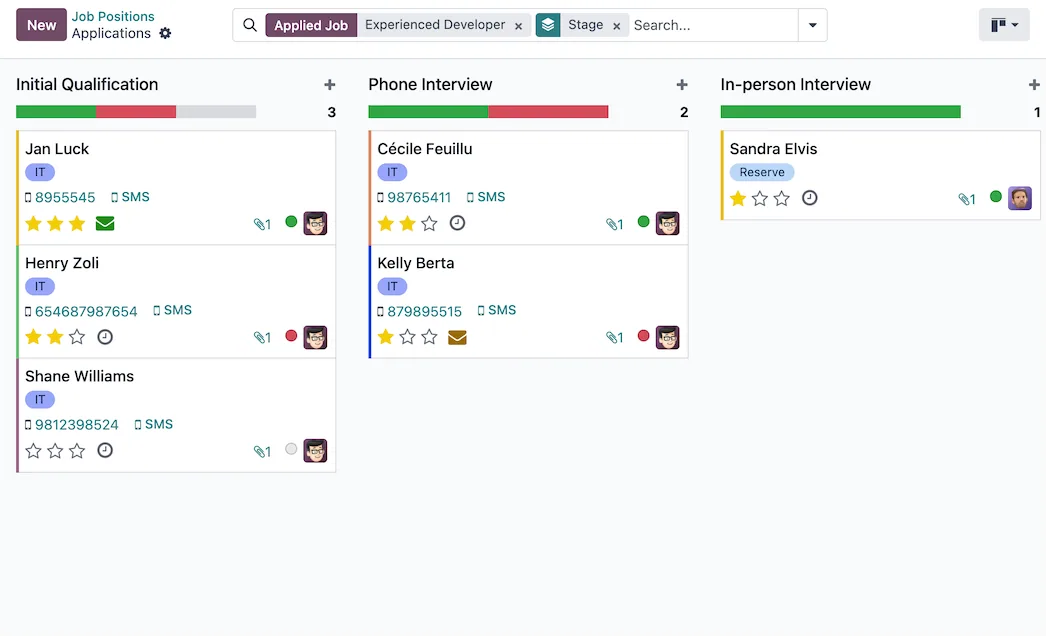
Applicants move through stages on a kanban board: typically new, qualified, first interview, second interview, contract proposal, contract signed.
The rule from every other pipeline in Odoo holds here too. A stage should describe where the candidate is, not what the recruiter intends to do. "First interview" is a stage. "Need to chase the hiring manager" is an activity.
Degree of fit, expected salary, availability and source are all on the record. Source is worth filling in consistently, because it is the only way to learn which channels produce hires rather than applications, and that answer usually surprises people.
04
Interview forms, which are how you make comparison possible
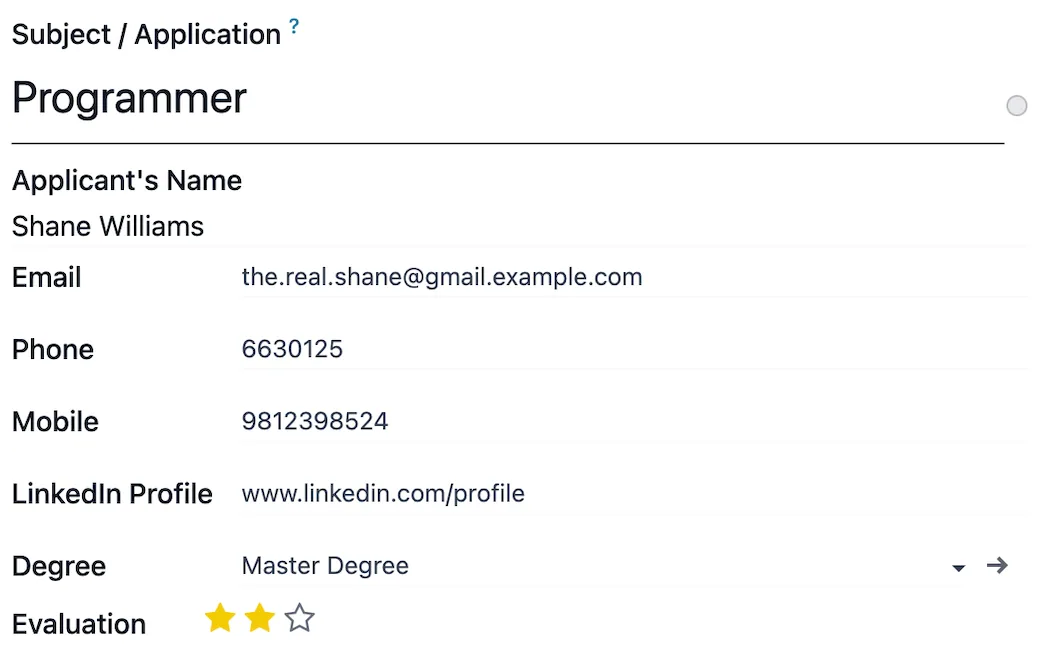
An interview form is a questionnaire attached to a job position, completed either by the candidate as a screening step or by the interviewer during the conversation.
The value is consistency. Unstructured interviews compared afterwards from memory reliably favour whoever was interviewed most recently and whoever was most similar to the interviewer. The same questions asked of every candidate, recorded on the record, is a cheap and well-evidenced improvement.
It only works if the form is actually used every time. A form completed for three candidates out of eight is worse than none, because it looks like evidence.
Screenshots of Odoo are the property of Odoo S.A. and are shown here to illustrate the app they depict.
Hiring, and the handover that justifies the module
Creating the employee from the applicant carries the details across. No retyping, no lost documents, and the new employee is immediately visible to Time Off, Timesheets, Payroll and everything else that works from hr.employee.
This is the payoff. It is a small moment and it removes a reliably annoying half-day of administration per hire, along with the transcription errors that come with it.
Where Odoo Recruitment will fight you
Job board syndication is weak. Publishing to your own site is built in. Getting onto the big boards means third-party tooling or manual posting, and if your hiring depends on those boards this may be decisive.
Sourcing tools are absent. There is no candidate search, no talent pool mining, no outreach sequencing. Odoo tracks people who applied; it does not help you find people who have not.
Reporting is basic. Time to hire, source effectiveness and pipeline conversion are derivable, and they are not presented as a recruiting analytics suite.
Retention and privacy policy is yours. The mechanics of deletion and access control exist. Deciding how long you keep unsuccessful applicants' data, and actually doing it, is a process you own.
How it connects to everything else
Job positions belong to departments in HR. A hired applicant becomes an employee, who then appears in Time Off, Attendance, Timesheets and Payroll. The careers page is your Odoo Website. Interview scheduling uses the same calendar as the rest of the business, so an interviewer's availability reflects their actual diary.
Where to start
Set up one job position completely, including the email alias and an interview form, before creating several. Define your stages to describe candidate state and keep them few. Insist on the source field being filled, since it is the only cheap analytics you get. Close positions when they are filled. Then hire one person through it end to end and check that the employee record that comes out the other side is one you would have been happy to create by hand.
FAQ
Odoo Recruitment, answered.
Is Odoo Recruitment free?
Yes, it is in Community, including job positions, the applicant pipeline, email aliases, the website careers page and interview forms. There is no licence cost to run a full hiring process.
How do applications arrive?
From the careers page on your Odoo website, from an email alias per job position, or by manual entry. The alias is the useful one, because a CV emailed to it becomes an applicant with the attachment already on the record.
Does it publish jobs to job boards?
It publishes to your own website out of the box. Posting to external boards depends on third-party apps or manual posting, and this is one area where dedicated recruitment platforms are clearly ahead.
What happens when someone is hired?
The applicant record converts into an employee, carrying the name, contact details, job position and documents across. This is the main reason to run hiring inside Odoo rather than beside it.
Can we score candidates consistently?
Yes, through interview forms attached to a job position, which are questionnaires completed by the interviewer or the candidate. Using the same form for every candidate on a role is what makes the comparison mean anything.
Is candidate data handled properly for privacy rules?
The tooling is there, in that records can be archived and deleted and access restricted to recruiters. The retention policy itself is yours to define and enforce, and no ERP does that part for you.
With CODEerts
Want this set up properly?
We are certified Odoo partners. We implement, customise and support Odoo Recruitment, and we publish our own apps on the Odoo Store.
See how we can helpBook a callReady to make Odoo work the way your business does?
Book a free call CODEerts
CODEerts is a team of certified Odoo partners and full-stack engineers. We implement, customise and support Odoo ERP, then build the software around it.