CODEerts

Odoo Fleet
Odoo Fleet: What Each Vehicle Actually Costs You
Most businesses know what their vehicles cost in total and cannot say what any individual one costs. Odoo Fleet exists to answer that second question, which is the one that tells you which vehicle to replace and which lease was a mistake.
Written by Muneeb AhmadOdoo 19 and 17 Certified, Functional Consultant
01
What Odoo Fleet actually is
Odoo Fleet is a register of vehicles and the costs attached to them. It records what you own or lease, who drives it, what it costs each month, what has been done to it, and what it has cost in total.
It is deliberately not a telematics system. There is no live tracking, no driver behaviour scoring, no route replay. If those are what you need, Fleet is not the answer and no amount of configuration makes it one.
What it does answer is the question most businesses cannot: what does this specific vehicle cost per month, per kilometre, per year, compared with that one. That is the number behind every sensible replacement and lease-renewal decision, and it is normally spread across an insurance folder, a fuel card statement and a garage's invoices.
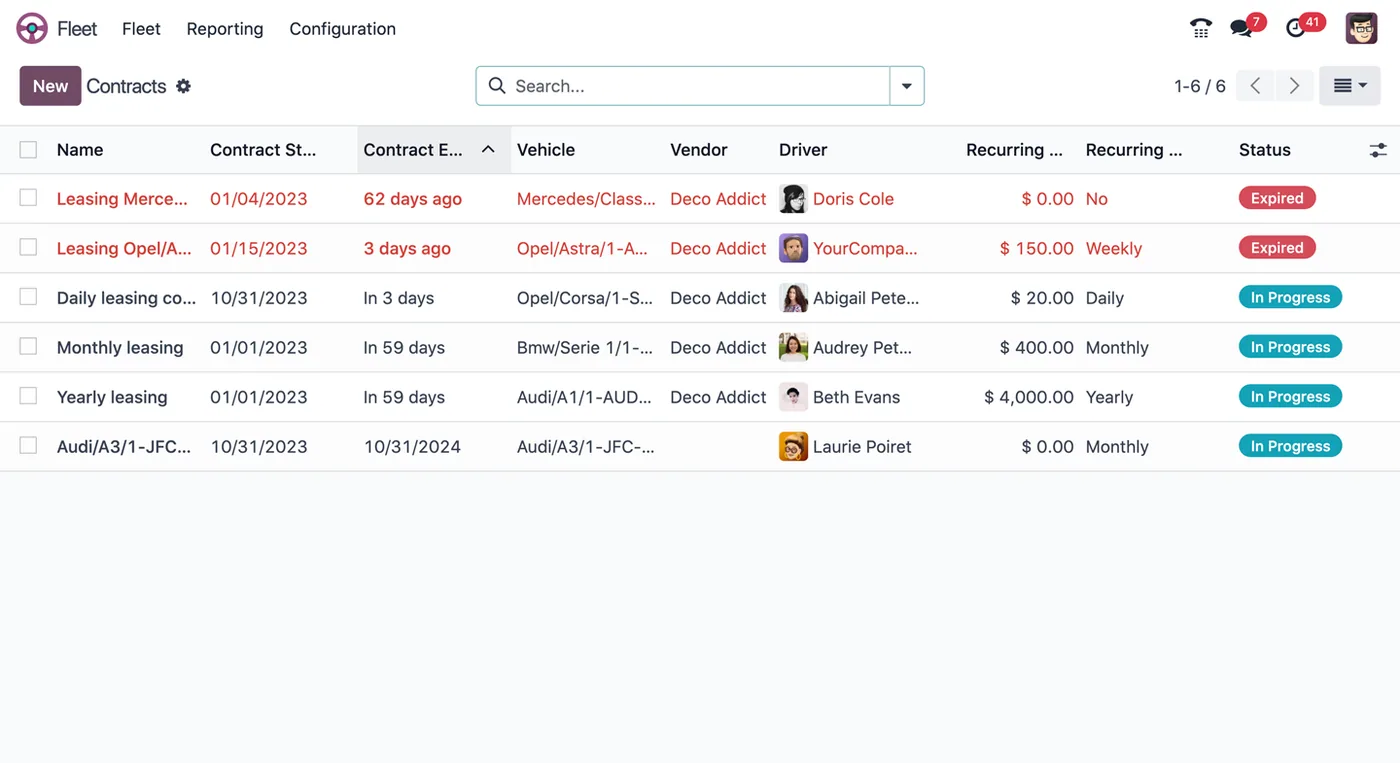
Screenshots of Odoo are the property of Odoo S.A. and are shown here to illustrate the app they depict.
The vehicle register
A vehicle record holds the model and manufacturer, registration, chassis or VIN, acquisition date and value, the driver, the fuel type, and the current odometer reading.
Model and manufacturer are structured rather than free text, which matters more than it appears: it is what lets you compare running costs across vehicles of the same model, and that comparison is often the first genuinely useful output.
Odometer readings are the input that turns absolute cost into cost per kilometre. Capturing them needs a habit, usually attached to fuelling or servicing. Without them you can still see what a vehicle costs; you just cannot see whether it is expensive because it is unreliable or because it does three times the mileage.
Drivers, and why assignment is history rather than a field
A vehicle has a driver, and Odoo keeps the assignment as a dated history.
That distinction is the practically important one. Six months after a speeding fine, an accident or a disputed fuel transaction, the question is not who drives the van now, it is who had it on the fourteenth. A single current-driver field cannot answer that. An assignment history can, and it takes no extra effort at the time.
Contracts and recurring cost
Contracts cover leasing, insurance, servicing agreements and anything else with a recurring charge and a renewal date. Each carries a cost and a frequency, and those feed the vehicle's total.
Two things come out of this. The first is that recurring cost lands on the right vehicle automatically rather than being apportioned at year end. The second is renewal visibility: contracts expire, and an insurance policy that lapses because nobody was watching the date is an expensive administrative failure that a due-date activity prevents.
Services, fuel and building a real total
Services record repairs, maintenance and inspections with their cost and date. Fuel logs record refuelling with volume, cost and odometer.
Completeness is everything here. A vehicle whose lease is recorded and whose repairs are not looks cheap and reliable. The cost-per-vehicle report is only as honest as the recording habit behind it, and a partial habit is actively misleading because it produces a confident number.
Decide at the outset which cost types must be recorded, make one person responsible, and check after a quarter that the fleet total reconciles roughly with what finance actually paid. If it does not, the report is not yet usable and should not be used to make a replacement decision.
Where Odoo Fleet will fight you
No telematics. Restating it because it is the most common mismatch of expectation.
Data entry is manual. Fuel cards, garages and lease companies all produce data in their own formats, and none of it flows in by default. High-volume fleets should plan an import route rather than typing.
Reporting is straightforward. Cost by vehicle, by type and by period is available. Sophisticated fleet analytics such as optimal replacement modelling are not.
Overlap with Maintenance causes confusion. Choose Fleet for vehicles and stay consistent.
How it connects to everything else
Drivers are employees from HR. Vehicle costs post to Accounting, and with analytic accounts they can reach the project or department that used the vehicle. Field Service technicians drive fleet vehicles, and van stock, if you model it, is an Inventory location on the same vehicle. Purchases of vehicles and services can originate in Purchase.
The analytic link is the one worth setting up if your vehicles serve identifiable jobs, because vehicle cost that reaches project profitability is the difference between knowing a job was profitable and knowing it was profitable before travel.
Where to start
Register the vehicles with their real acquisition values and current odometer readings. Enter every active contract with its renewal date, since that alone often justifies the setup. Decide who records fuel and services, and make it one person. Capture odometer readings at every fuelling. Then run the cost report after a quarter and reconcile it against what finance actually spent, because until those agree the numbers are not yet a basis for decisions.
FAQ
Odoo Fleet, answered.
Is Odoo Fleet free?
Yes, Fleet is in Community, covering the vehicle register, drivers, contracts, services, fuel logs and odometer readings. There is no licence cost.
Does it do GPS or live vehicle tracking?
No. Fleet is a records and cost system, not a telematics platform. Live location, driver behaviour scoring and route replay require dedicated telematics hardware and software, which would need integrating.
How does it calculate cost per vehicle?
It totals the recurring costs from contracts such as lease and insurance, plus logged services, repairs and fuel, against each vehicle. The figure is only as complete as the costs you actually record, so a partial habit produces a flattering number.
Can it track who was driving which vehicle and when?
Yes. Driver assignment is held as history rather than a single current value, so you can establish who had a vehicle on a given date. That matters for fines, incidents and fuel-card queries.
Does it remind you about renewals and services?
Contracts and services carry expiry and due dates that surface as activities, so insurance renewals, inspections and scheduled servicing can be caught before they lapse rather than after.
Should vehicles live in Fleet or in Maintenance?
Fleet, in almost every case. It models drivers, contracts, fuel and odometers, which Maintenance does not. Pick one and be consistent; recording the same van in both produces two partial histories and no complete one.
Related
Keep exploring.
Other Odoo apps we have written up in the same depth.
With CODEerts
Want this set up properly?
We are certified Odoo partners. We implement, customise and support Odoo Fleet, and we publish our own apps on the Odoo Store.
See how we can helpBook a callReady to make Odoo work the way your business does?
Book a free call CODEerts
CODEerts is a team of certified Odoo partners and full-stack engineers. We implement, customise and support Odoo ERP, then build the software around it.