CODEerts

Odoo Maintenance
Odoo Maintenance: Preventive Work on the Equipment That Actually Runs
Maintenance is the cheapest module in Odoo to install and the hardest to sustain, because its value arrives months later and its cost is a job somebody has to do this week. The equipment register is what makes the difference.
Written by Muneeb AhmadOdoo 19 and 17 Certified, Functional Consultant
01
What Odoo Maintenance actually is
Odoo Maintenance keeps a register of equipment and manages the work done on it, both the unplanned repairs and the scheduled servicing meant to prevent them.
It is a small module, it is free, and it is genuinely useful in a way that is disproportionate to its size, because most organisations have no equipment history at all. Machines get fixed, the knowledge lives with whoever fixed them, and when that person leaves so does the answer to why the same fault keeps recurring.
The catch is that its value is delayed. The equipment register costs effort now and pays back when someone asks a question about a machine in six months. That asymmetry is why maintenance modules get installed and abandoned, and it is worth naming before you start.
Screenshots of Odoo are the property of Odoo S.A. and are shown here to illustrate the app they depict.
The equipment register, which is the whole foundation
Equipment records the asset, its category, the technician or team responsible, its location, its serial number, the vendor, warranty dates, and where relevant the work centre it belongs to.
Building this register is the real work of implementing the module and it is tempting to do it thinly. Resist that for the fields that will be asked about later: warranty expiry, because knowing an asset is still covered before you pay for a repair pays for itself quickly, and assigned owner, because equipment with no owner accumulates requests that go to nobody.
Start with the equipment whose failure actually stops something. A complete register of every desk fan and an incomplete one of your production line is the wrong way round.
Corrective requests, which are what people will actually use
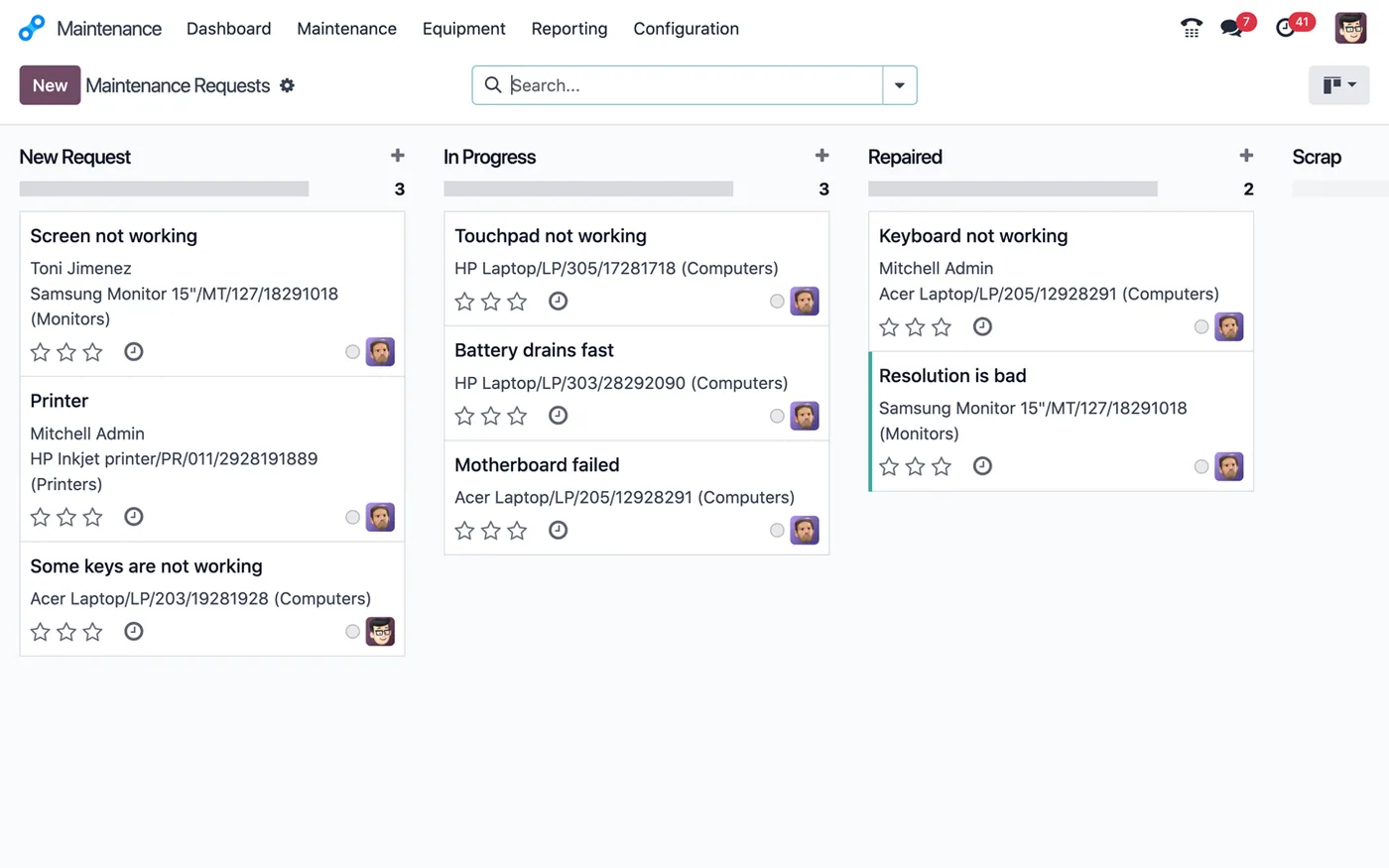
A corrective request is raised when something breaks. It moves through stages on a kanban board: new, in progress, repaired, scrapped.
Let operators raise these directly. The instinct is to route reports through a supervisor for filtering, and the result is that small faults go unreported until they become large ones. The form is short, and a slightly noisy request queue is far more useful than a quiet one.
The value compounds silently. After a year, the request history against a machine answers whether it is worth repairing again, whether a fault is recurring, and whether a supplier's equipment is as reliable as they claimed.
Preventive maintenance and the shift that matters
Preventive requests are generated on a schedule, either by time or by a usage meter on the equipment.
Usage-based is the better mechanism wherever a meter exists. A machine that ran flat out for six weeks and one that sat idle should not be serviced on the same calendar, and a time-based schedule either over-services the idle one or under-services the busy one.
The metric worth tracking is the ratio of preventive to corrective work. A maintenance operation that is entirely corrective is firefighting, however efficiently it does it. Moving that ratio is the whole point of the module, and it is a slow move that needs somebody watching it, otherwise the preventive schedule quietly gets deferred every time production is busy.
Where Odoo Maintenance will fight you
Sustaining it is harder than starting it. The register goes stale, preventive requests get closed without being done, and within a year the data is worse than useless because it looks authoritative. This needs an owner, not just a configuration.
Spare parts are not modelled as a maintenance workflow. Spares are Inventory, and the link between a repair and the parts it consumed is something you have to design. For parts-heavy maintenance operations this is a real gap.
Reporting is basic. Request counts, categories and durations are available. Formal reliability metrics such as mean time between failures are not presented, though the underlying data supports deriving them.
It is not a full asset-management system. Depreciation, asset valuation and capital planning belong in Accounting, not here.
How it connects to everything else
Equipment links to work centres in Manufacturing, so maintenance affects visible production capacity and downtime attributes to a specific machine. Equipment can also be assigned to employees, which covers laptops and vehicles as well as machinery. Quality failures traced to equipment rather than material can raise maintenance requests. Fleet handles vehicles specifically, and the two overlap, so decide which owns vehicles rather than recording them in both.
Where to start
Register only the equipment whose failure stops work, and fill in warranty and owner properly for those. Let operators raise corrective requests themselves from day one. Add preventive schedules for a handful of critical assets, using meters rather than dates where a meter exists. Give the whole thing a named owner. Then check the preventive-to-corrective ratio after two quarters, because that single number tells you whether the module is being used or merely installed.
FAQ
Odoo Maintenance, answered.
Is Odoo Maintenance free?
Yes, Maintenance is in Community, including the equipment register, maintenance teams, corrective and preventive requests and the kanban workflow. There is no licence barrier to starting.
What is the difference between corrective and preventive maintenance?
Corrective is a request raised because something broke. Preventive is scheduled before anything breaks, on a time interval or a usage threshold. A healthy maintenance operation shifts the ratio toward preventive over time, and that ratio is the metric worth watching.
Can maintenance be triggered by usage rather than by date?
Yes. Equipment can carry a meter reading, so a request can be scheduled every so many hours or cycles rather than every so many weeks. For equipment with uneven utilisation this is far more accurate than a calendar.
Does it link to Manufacturing?
Yes. Equipment can be tied to a work centre, so maintenance on that equipment is visible against production capacity and downtime can be attributed to the machine that caused it rather than absorbed generally.
Can shop-floor staff raise requests?
Yes, and they should. A request is a short form, and the fastest route to a useful equipment history is letting the people who operate the machines report faults directly rather than through a supervisor.
Does it handle spare parts and stock?
Not natively as a parts-consumption workflow. Spares live in Inventory and consumption is recorded separately, so a business whose maintenance is dominated by parts management should plan how the two connect before relying on it.
Related
Keep exploring.
Other Odoo apps we have written up in the same depth.
With CODEerts
Want this set up properly?
We are certified Odoo partners. We implement, customise and support Odoo Maintenance, and we publish our own apps on the Odoo Store.
See how we can helpBook a callReady to make Odoo work the way your business does?
Book a free call CODEerts
CODEerts is a team of certified Odoo partners and full-stack engineers. We implement, customise and support Odoo ERP, then build the software around it.