CODEerts

Odoo Quality
Odoo Quality: Checks Inside Production Rather Than Alongside It
Almost every manufacturer already does quality control. The question Odoo Quality answers is whether the result of that control is attached to the lot, the operation and the supplier, or whether it lives in a folder nobody opens until something goes wrong.
Written by Muneeb AhmadOdoo 19 and 17 Certified, Functional Consultant
01
What Odoo Quality actually is
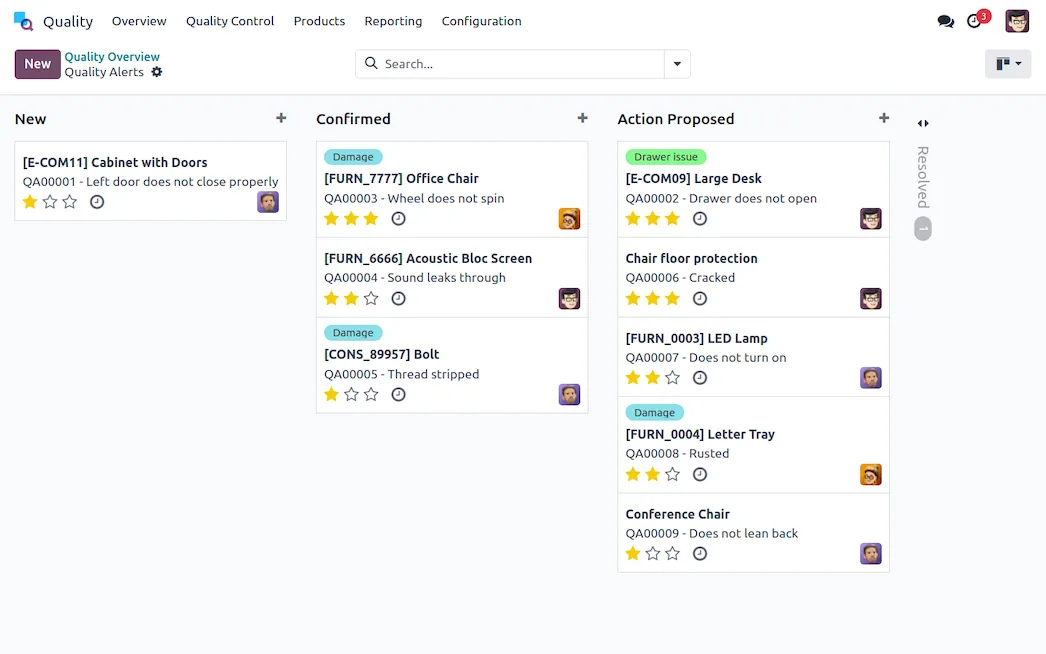
Odoo Quality attaches inspection to the operations that already happen: receiving goods, manufacturing steps, and shipping. It defines where a check is required, prompts the person doing the work, records the result against the specific lot and operation, and manages what happens when a check fails.
It is an Enterprise app.
The distinction it draws is worth stating carefully, because most manufacturers hear "we already do quality control" and stop listening. The question is not whether you inspect. It is whether the result of the inspection is attached to the thing inspected. A folder of signed check sheets tells you that inspection happened. A check recorded against lot number and work order tells you which customers received product from a batch whose third measurement was drifting toward the tolerance limit, and it tells you in minutes rather than days.
02
Control points, which decide where checking happens
A quality control point specifies the product or category, the operation type, the check type, and the frequency.
The design decision that matters is where the check sits. A check on the operation is completed by the person performing it, at the moment they perform it, and cannot be skipped without that being visible. A check performed separately afterwards is a second process that competes with production for time, and it is the one that gets compressed when the line is behind.
The frequency setting is what keeps this proportionate. Not everything needs inspecting every time, and a control regime that inspects everything trains people to click through. Sample where the risk allows and check fully where it does not.

03
Check types, and why measurement beats pass or fail
Pass or fail is the easiest to configure and the least useful over time. It tells you that today was fine.
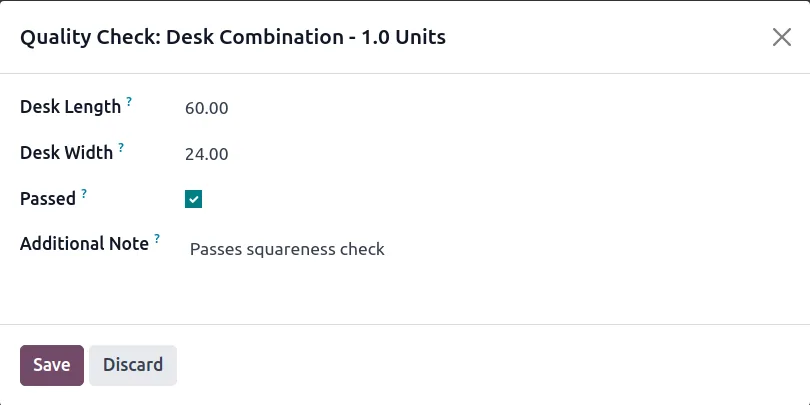
A measured value against a tolerance range tells you the same thing plus a trend. A dimension that has been drifting toward the upper limit for three weeks is a tool wearing out, and it is visible before anything fails. That is the difference between quality control and quality management, and it costs nothing extra to capture.
Use measurement wherever a number exists. Reserve pass or fail for things that genuinely are binary, and use instructions or photographs where the check is a procedure rather than a measurement.
04
Quality alerts and doing something about failures
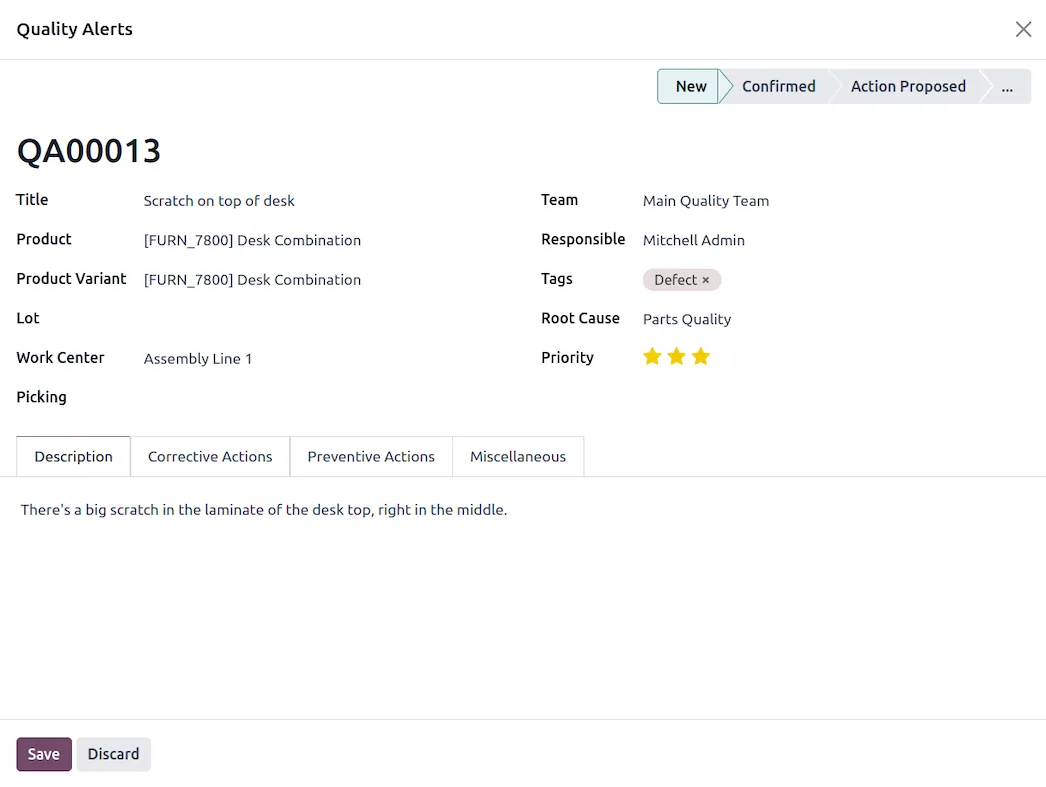
A failed check can raise an alert: assigned to a person, with a description, a root cause, a corrective action, and a stage it moves through to closure.
This is the part that most often goes unused, and it is the part that produces improvement. Recording failures without a closure process gives you a list of problems. The alert workflow gives you a record of what was done about them, which is both what an auditor asks for and what stops the same failure recurring quarterly.
Keep root causes as a short, specific list, for the same reason CRM lost reasons should be short and specific. A root-cause list where eighty percent of entries say "operator error" is a list that has stopped being read.
Screenshots of Odoo are the property of Odoo S.A. and are shown here to illustrate the app they depict.
Where Odoo Quality will fight you
It is Enterprise, and it assumes Manufacturing or Inventory is already running properly. Quality on top of a poorly configured production process measures the wrong thing precisely.
Over-inspection is the common failure. A control regime designed by someone who will not perform it tends to be thorough and unworkable. Design it with the shop floor, and be willing to remove checks that have never once failed.
Non-conformance handling is lighter than dedicated QMS software. Full CAPA management, document control and audit management are areas where specialist systems go further.
Someone has to own the alerts. An alert queue with no owner becomes a list nobody reads, and then the module is recording rather than managing.
How it connects to everything else
Control points fire on Inventory receipts, on Manufacturing work orders and on delivery operations. Results attach to the lot or serial number, so lot traceability in Inventory carries the quality history with it. Failures on incoming goods link to the vendor, which makes supplier quality a measurable thing rather than an impression. Maintenance can be triggered where a failure points at equipment rather than material.
The traceability link is the one worth designing for. When a customer reports a problem, being able to move from their delivery to the lot to the checks recorded on that lot is the difference between a targeted recall and a general one.
Where to start
Pick the three failures that have actually cost you money in the last year and put control points where those failures originate, rather than designing a complete regime up front. Use measured checks wherever a number exists. Assign an owner to the alert queue before you create the first alert. Then look at the measurement trends after a month, because the first thing that data usually shows is a check nobody needed and a check nobody had.
FAQ
Odoo Quality, answered.
Is Odoo Quality available in Community?
No, Quality is an Enterprise app. Community users sometimes approximate simple checks with work order instructions or custom fields, which records that a check happened but gives you no alert workflow, no measurement history and no non-conformance trail.
What is a quality control point?
A rule that says a check must happen at a defined moment: on receipt of a product, at a manufacturing operation, or before delivery. It defines what is checked, how often, and what type of check it is, and Odoo then creates the check automatically at that moment.
What types of check are supported?
Pass or fail, a measured value against a tolerance range, a printed instruction to follow, a photograph, and a worksheet for multi-point inspection. The measured type is the one worth using wherever possible, because it produces trend data rather than a binary.
What happens when a check fails?
A quality alert can be raised, assigned to someone, given a root cause and corrective action, and tracked to closure. The alert stays linked to the lot, operation and partner involved, which is what makes later analysis possible.
Can checks be sampled rather than done every time?
Yes. A control point can apply to every unit, to a periodic sample, or to a percentage, which keeps the checking burden proportionate to the risk rather than inspecting everything by default.
Does it help with ISO or regulatory audits?
It produces the evidence trail an audit asks for: what was checked, when, by whom, with what result, and what was done about failures. It does not itself certify anything, and the procedures behind the records remain yours to define.
Related
Keep exploring.
Other Odoo apps we have written up in the same depth.
With CODEerts
Want this set up properly?
We are certified Odoo partners. We implement, customise and support Odoo Quality, and we publish our own apps on the Odoo Store.
See how we can helpBook a callReady to make Odoo work the way your business does?
Book a free call CODEerts
CODEerts is a team of certified Odoo partners and full-stack engineers. We implement, customise and support Odoo ERP, then build the software around it.